 |
|
|
|
The End of the Electorate of Hannover by N. Ludlow Beamish |
|
Volume I • Chapter V
|
|
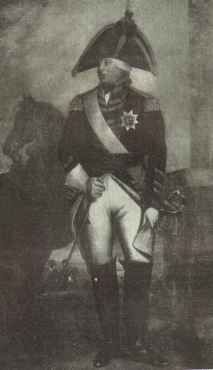
King George III While the eventful incidents which have been detailed were passing in Lauenburg, the greatest anxiety concerning the fate of his Hanoverian soldiers reigned in the breast of their affectionate sovereign. It has been shewn how, dissatisfied as was the king with the convention of Suhlingen, and the tame submission of the electoral ministry to the demands of the invader, his majesty, believing that a faithful observance of the conditions which had been imposed upon the troops by the convention would now best serve the interests of the electorate, had authorized lord Hawkesbury to state, that "until informed of the sentiments of the empire and those powers of Europe who guaranteed the Germanic confederation, his majesty, as elector of Hanover, would scrupulously abstain from doing any act which could be considered as being in contravention to the stipulations contained in the convention of Suhlingen;" and that the king had, in accordance with these sentiments, issued express orders that the convention should be strictly observed on the part of the Hanoverian army, and had consequently countermanded the transports which were intended for the conveyance of that army to England. When, however, on the 8th of July, intelligence had reached London that Mortier had put his troops in motion for the Elbe, and, violating the convention in virtue of which he had secured most important advantages, now put forth new and most unwarrantable demands; the former design of removing the army to England again became an object of royal solicitude. His majesty’s wishes were anticipated by an active member of the Hanoverian diplomatic body in London. Mr. Lewis Moeller, secretary to the department (Now Sir Lewis Moeller, K.C.H., privy counsellor of legation, and secretary to the royal Hanoverian Guelphic order.), who was to have accompanied the transports to the Elbe in the first instance, and had remained keenly watching the progress of events, saw at once the importance of the present moment, and repairing to Windsor on the evening of the 9th, requested that he might be permitted to proceed on his original mission, and endeavour to effect the embarkation of the troops. The king entered with much warmth into the views and feelings of his zealous servant, and provided him on the following day with a requisition to the admiralty for the necessary number of transports. In anticipation of the king’s approval, the secretary had prepared a short proclamation to authorize the removal of the troops, which his majesty readily signed, declaring, with much satisfaction, "that it was the only document unauthenticated by the counter-signature of the minister, to which he had ever subscribed." Thus all things seemed favourable to the execution of the plan; but scarce had its details been entered into, when accounts from Lauenburg threw doubts over its fulfilment; soon came the mortifying intelligence that a second convention had been concluded between the French and Hanoverian armies. This destroyed the operation altogether, and the transports were again and finally countermanded. Moeller’s exertions in the cause of his countrymen were not, however, on that account discontinued. Some vessels had been appointed to convey to England the electoral stud and other property of his majesty, which had been removed for safety to Mecklenburg, and with these he conceived the design of embarking. In this province he felt sure of meeting with many officers and soldiers of the disbanded army, whose future prospects he hoped, by means of the king’s proclamation, and his own personal assurance of the royal sentiments, to place before them in a more cheering light, and thus direct their steps towards England. His majesty assented to the departure of the secretary, as also to the issuing of an order from the admiralty, which he had suggested, authorizing all British vessels cruizing off the German coast, to take on boars and convey to England any Hanoverian officers, non-commissioned officers, or men, who might solicit that indulgence. This was immediately forwarded, and having been acted upon without delay, materially aided the emigration of the troops. Provided with his majesty’s proclamation, Mr. Moeller sailed from the Nore on the 19th of July, and on arriving in Mecklenburg had the gratification to find that his hopes had been well founded; many officers would immediately have embarked with him for England, but considered, on reflection, that by secretly disseminating the cheering intelligence of which he was the bearer, they would best promote an object in the success of which they were so deeply interested. Meantime lieutenant-colonel von der Decken, who, on a visit to England in April, had been given reason to suppose that he would be empowered to raise a corps of foreign troops for the English service, had been officially established at the head of a recruiting department in London, with authority to raise a corps of foreigners not exceeding four thousand men. At this department, therefore, Moeller recommended those officers and soldiers of the late army whom he met in Mecklenburg, to present themselves, and the gratifying assurance of his majesty’s considerate sentiments, which he conveyed to them, joined to their own well grounded confidence in the generous feelings of the monarch, soon pervaded the scattered ranks of the disbanded Hanoverians, and prepared the way to their reunion under the banners of England. The principal impediment to the emigration of the troops was raised by their own ministry and general officers, the most of whom, apprehensive that such an infraction of the third article of the Elbe convention would be visited upon the conquered country by a more severe treatment of the inhabitants, endeavoured to deter them from leaving the continent. But the situation of the disbanded soldiers in their own country was too galling, and the prospect which offered itself to them in England too favourable, to allow of their long hesitating as to the course which they should pursue. The insulting demeanour of the French military - the painful aspect of their native land - the doubtful and distant prospect of her emancipation - gradually operated to overcome their natural reluctance to abandon their friends and families, and led them finally to place their whole dependance upon British protection. The hurried and careless manner in which the last convention had been concluded, much favoured the scheme of embarkation. No promise not to serve against France had been required of the troops; in fact the Elbe convention was never officially communicated, and first became known to them through the public papers; they were, therefore, in nowise bound to observe its restrictions. A rescript in the king’s name was also published by the several British ministers at the German courts, which explicitly absolved his majesty’s Hanoverian subjects from the observance of all conventions which his ministers or generals might, without his majesty’s ratification, enter into with the French. Thus no moral objection to the departure of the troops can be said to have existed. To this step the French did not offer any serious impediment - perhaps the known loyalty of the troops prevented any over-anxiety to detain them on the part of the new government; and a free passage through Holstein having been generously granted by the king of Denmark to those Hanoverians desirous of embarking for England, little difficulty presented itself to their progress to the coast. But although the French prudently abstained from employing any forcible means of preventing the departure of men, whose abode, as civil inhabitants, in their new possession might have been dangerous to its peace, they omitted not to tempt them with offers which were calculated to procure their stay, under the more advantageous condition of military service. A corps to be called the "French Hanoverian Legion" was proposed to be organized, and in this the disbanded officers and soldiers were invited to enrol themselves; but, attractive as this proposition doubtless was to those officers whose professional incomes had alone afforded to themselves and families the means of support, honour and loyalty maintained their influence over the general body, and two only (One lieutenant an two ensigns of the disbanded army entered the French service; but one of these was a native of Denmark.) were induced to take service in the ranks of the French. Lieutenant-colonel von der Decken was, as has been stated, empowered to raise a corps of foreigners for the British service, not exceeding four thousand men. The letter of service which invested him with this authority, was issued from the commander-in-chief’s office on the 28th of July, and held out to the Hanoverians nearly all the advantages which government offered to recruits enlisted for British regiments. Lieutenant-colonel Decken was to have the rank of colonel, and fifteen guineas for each recruit on approval, the bounty being seven pounds, twelve shillings, and six pence. It was, however, stipulated that if four hundred approved recruits should not have been raised within three months from the date of the letter of service, it should be at the option of his majesty to order the levy to be discontinued; the king also reserved to himself the power of putting an end to the present agreement upon giving two months’ notice. The same day on which the letter of service was issued to colonel Decken, a similar authority was given to major Colin Halkett, of the Dutch service, empowering him to raise, on nearly the same conditions, a battalion of infantry with an establishment of four hundred and fifty-nine men, and offering him the rank of lieutenant-colonel should he increase the number to eight hundred men. The first individuals of the late Hanoverian army who landed in England were major von Hinüber, captain Offeney, and cornet Augustus Heise. These officers left Lauenburg immediately after the Elbe convention had been concluded, and were forthwith put in requisition by colonel Decken to assist in the formation of his new corps. The town of Lymington, in Hampshire, was appointed the place of rendezvous for the recruits, whose examination and outfit were here carried on. Officers were also stationed at Plymouth and Harwich, from which ports the men were forwarded to Lymington. (See Map of England from Schwertfeger) The commencement of the recruiting was far from promising. on the 8th of August not more than seven men had been enlisted. The British government, therefore, thought it advisable to give more publicity to the king’s design, and his royal highness the duke of Cambridge having expressed his readiness to take the command of the corps which it was intended to raise, the following proclamation was made public. "10th August, 1803. "His majesty George the Third, king of the united kingdoms of Great Britain and Ireland, has been pleased to grant letters of service to colonel baron Decken, for raising a corps of light infantry for the British service, which is to be called the KING’S GERMANS, and which, when completed, will be under the command of his royal highness the duke of Cambridge. All foreigners, and especially all brave Germans, are therefore called upon to enlist in the said corps. They will receive a very considerable bounty, and are to enjoy the same pay and prerogatives as the regular regiments in the British line. "Those who are disabled during the war are also to have pensions. Each recruit is to engage for seven years, and for half-a-year after the signature of a future definitive treaty of peace, after which he will be discharged, and is then to receive an adequate sum of money to defray his expenses home." Advantageous as were the terms which his majesty’s proclamation offered, little immediate effect appears to have been produced by it, and serious apprehensions began to be entertained that colonel von der Decken would be unable to comply with that condition of his letter of service which limited the period allowed him for the raising of four hundred men, to three months. In this event, the men which should have been already enlisted were to be distributed throughout the British West India regiments, and the result of the first ten weeks’ recruiting was so unpromising, that such a consequence appeared far from improbable. Towards the end of September, however, colonel Decken’s prospects brightened; the design of the English government had become known in Hanover, and the Hanoverian officers spared no exertion to promote its fulfilment. Several hundred recruits were now expected in England, and these arrived at Lymington so suddenly and in such numbers, that the depôt was soon overstocked, and it became necessary to remove a part of the men to Parkhurst barracks in the Isle of Wight. So favourable a change in the progress of the recruiting had now taken place, that it was no longer found necessary to continue the stations at Plymouth and Harwich; and major von Hinüber, who had been in superintendence at the former place, was therefore removed to the Isle of Wight, where, on the 13th of October, he took the command of the KING’S GERMAN REGIMENT, as the new corps was first entitled. The increasing emigration from Hanover appears. about this time, to have alarmed the French. On the 6th of October a proclamation was issued by the executive commission, warning the magistrates not to encourage recruiting for the English army, and requiring them to give information against all persons found to be so engaged. This was followed, on the 10th, by another proclamation, in which the inhabitants were informed that any one who was engaged in recruiting for the English army, or induced others to enter the English service, would be given up to the French military tribunal, and punished, according to its laws, with death. This formidable warning was read for three successive Sundays in the public churches; but notwithstanding the severity of the threatened sentence, and the imposing manner in which it was denounced, the agents of the new corps continued their exertions, and except in one instance appear to have evaded the vigilance of the French. The case in question was that of a sergeant named Ahrens, who was apprehended and brought to trial on the charge of embauchage, or secret recruiting, of which he was found guilty; but the majority of his judges being against the extreme punishment of death, the sentence was commuted to fifteen years’ imprisonment in irons! The number of officers who had now arrived in England was so much greater in proportion than that of men, that it was not possible at once to provide them with suitable appointments in the new levy, and therefore to obviate this inconvenience to the individuals, the British government liberally allowed each Hanoverian officer, from the day of his arrival until that of his gazettement, two thirds of the pay to which British officers of similar rank were entitled. On the 3d of November, the number of recruits at the Isle of Wight amounted to four hundred and fifty, and the continuance of the levy was consequently secured. The original plan of forming a regiment only was now extended, and a corps consisting of cavalry, infantry, and artillery and engineers was proposed to be raised. The better to effect this object, the independent levies of colonel von der Decken and major Halkett were ordered to be discontinued, and the men that had been already enlisted by those officers to be incorporated as the basis of a legion, which his majesty was pleased to authorize should be raised by his royal highness the duke of Cambridge. This corps was not to exceed five thousand men, which were to be enlisted, if possible, for ten, but certainly for not less than seven years. The other conditions of the letter of service, by virtue of which his royal highness was empowered to raise the legion, were nearly similar to those by which colonel von der Decken and major Halkett had been restricted. His majesty also held himself free to discontinue at pleasure the new corps or any part thereof, even although the period of enlistment should not have expired. Letter of service addressed to War Office, 19th December, 1803. SIR, In pursuance of the king’s commands, communicated to me by his royal highness the commander-in-chief, I have the honour to acquaint your royal highness that his majesty has directed the independent levies of baron Decken and major Halkett to be discontinued, and has been pleased to order that the men raised under the letters of service granted to those officers shall be formed into a legion to be composed of foreigners, not exceeding five thousand men, which his majesty is pleased to authorize to be raised by your royal highness, upon the conditions hereafter specified. Article I. – Each recruit is to be enlisted for ten years if possible, but certainly for not less than seven years; and should Great Britain be at war at the expiration of that term of service, the men are to continue to serve without additional bounty until six months after the ratification of a definitive treaty of peace. No man engaged for a less term of service will be passed at the depôt at Hilsea barracks. II. – The recruits are not to be under five feet three inches, nor above forty years of age, and must, in every respect, be free from infirmity and fit for service. Young healthy lads who are likely to grow, may, however, be enlisted at five feet two inches high. III. – No natives of France, Italy, or Spain are to be enlisted under any circumstances whatever; but your royal highness is at liberty to engage abroad, men of all other nations of Europe, and also Poles, Hungarians, Danes, Russians, and Germans residing in this country, but not any of his majesty’s British subjects; and your royal highness is also at liberty to engage natives of Holland, taken on board prizes, provided they shall appear from their age and make to be fit for his majesty’s service. IV. – Fifteen guineas will be allowed to your royal highness for each recruit (those men brought from the Continent at the public expense, also those enlisted from on board prizes, and the lads excepted) who shall be delivered at Hilsea barracks, and there approved and accepted for his majesty'’ service, reserving, however, the sum of three pounds, seventeen shillings, and sixpence, being the like proportion of the bounty, both in money and in necessaries, that is allowed to a British recruit of the line on final approval; the same to be invariably accounted for to your royal highness’s recruits at the depôt, under the order of the inspector-general. The man is also to be in possession of all the other articles of necessaries furnished to a recruit of the line on intermediate approval. The bounty paid to the recruit is not, however, in any case to exceed, in money or necessaries, the regulated sum of seven pounds, twelve shillings, and sixpence, now allowed to a British infantry recruit. V. – For each man brought from the Continent at the public expense, the sum of twelve guineas will be allowed, and those who shall be enlisted from on board prizes, and who shall be approved and accepted of as above stipulated, levy money at the rate of seven guineas will be allowed, and eight guineas for each lad of the description mentioned in article II. with the like reservation of bounty in each case as in article IV. VI. – No charge whatever will be admitted for any expenses that may be incurred on account of the recruit previous to the man’s approval at Hilsea barracks; nor is any expense to be incurred by the public on account of rejected recruits, or of such as may die or desert before approval. The rejected men brought from the Continent are to be subsisted and sent back at your royal highness’s expense. VII. – The pay of the approved recruits will be allowed from the respective dates of their approval at Hilsea barracks, and that of the officers from the date of their commissions. VIII. – The officers and men will be required to take the oath of allegiance to his majesty, and will be liable to serve wherever his majesty shall think fit to employ them. Each recruit is to sign an engagement accordingly, and to be subject to the same regulations and articles of war as his majesty’s British troops. IX. – The men and lads shall, during the whole period of their term of service, enjoy all such advantages as are or may be granted or allowed to British soldiers wherever they may happen to serve, and shall be subject to all diminutions of pay and allowances which his majesty may think proper to order for the British troops. X. – The whole of the officers shall be entitled on reduction to an allowance equivalent to British half-pay, provided the legion be kept in the British service for upwards of five years; but in the event of its being sooner reduced, this allowance will be granted to such officers only as shall hold permanent British rank. The rest of the officers will have allowances according to their respective ranks, at the rates specified in the table hereunto annexed. (Per diem: Colonel 7 s. 6 d.; Lieutenant-colonel and major 5 s. 0 d.; Captain and surgeon 3 s. 0 d.; Adjutant 2 s. 6 d.; Subaltern and assistant-surgeon 2 s. 0 d.) XI. – When any of the men shall be discharged from the service on reduction or otherwise, they will, if brought from the Continent, be sent back at the expense of the British government, and an allowance will be made to them in aid of travelling expenses to their respective homes, at the rate of twopence English, or about six kreutzers of the empire per league, the same to be calculated from the point of debarkation on the Continent. XII. – The men who, from wounds or other infirmities, shall become incapable of serving during the period of the term for which they shall have been engaged, will receive from government an allowance for life, not exceeding the Chelsea out-pension, which will be paid to them accordingly if they reside in England, or shall have obtained permission to receive the same on the Continent, but not otherwise. XIII. – In respect to the supply of clothing and appointments the legion will be on the same footing as British regiments of the line. The arms will be furnished from the public stores. XIV. – In the first instance, the men already raised are to be immediately formed into two battalions of light infantry, each battalion to consist of the numbers specified in the annexed statement (1 Lieutenant-colonel, 1 Major, 6 Captains, 6 Lieutenants, 6 Ensigns, 1 Adjutant, 1 Quarter-master, 1 Pay-master, 1 Surgeon, 1 Assistant-surgeon, 1 Sergeant-major, 1 Quarter-master-sergeant, 1 Pay-master-sergeant, 1 Armourer-sergeant, 24 Sergeants, 24 Corporals, 12 Buglers, 450 Privates, Total 539), which battalions will be considered as placed in the establishment of the army from the 19th of December, 1803. The formation of the remainder of the legion will take place in proportion as the men are obtained. XV. – His majesty, whenever he shall thin fit, may discontinue the legion or any part thereof, on the establishment of the army, notwithstanding the period of seven years, or such longer term for which the men shall have been engaged to serve, should not have expired. I have the honour to be, Sir, With the most profound respect, Your Royal Highness’s Most obedient and humble Servant, (Signed) C. BRAGGE. To lieutenant-general his royal highness the duke of Cambridge, K.G. &c. &c. &c. Meantime, major von Hinüber had been busily engaged in dividing and regulating the fast increasing numbers of his command at the Isle of Wight, which was, in the middle of November, removed to Hilsea barracks, and before the end of that month numbered about a thousand men. From these, the men fit for the cavalry and artillery services having been withdrawn, two light regiments and the foundation of one line battalion were formed. The light brigade being intended for a rifle corps, were clothed in green, while the line battalion was furnished with a uniform nearly similar to that worn by the British royal regiments of infantry. The organization of the cavalry and horse-artillery was commenced at Weymouth; that of the foot-artillery, at Hilsea. From the men intended for the cavalry service, and the most of whom were volunteers from the late Hanoverian army, four troops of heavy, and four of light, dragoons were formed; the heavy cavalry were clothed like the British royal regiments of heavy dragoons, the light regiment as the English hussars; the uniform of the artillery and engineers was in every respect similar to that of the same corps in the British service. The artillery were also principally furnished with recruits from the late Hanoverian army, and these, together with other foreigners who had already been in that branch of the service, arrived in such numbers before the end of the year, that one horse and one foot battery were by that time formed. Thus, in less than six months from the period of the dissolution of the Hanoverian army in Lauenburg, its scattered elements had been re-united in England, and now formed the basis of that corps which was henceforward to bear the name THE KING’S GERMAN LEGION.
from: History of the King's German Legion, Volume 1, London 1832 - 1837, Pages 69 - 81 © 2003 Michael-Andreas Tänzer |

)